



“Are there sharks in Germany?” asks a character in The Secret Agent, staring at the dreadful scars on an elderly Jewish tailor’s leg and torso. Indeed, there were, but rather than endlessly gliding through saltwater in search of food, they goose-stepped on land with their arms outstretched, palms down, in search of victims. In Kleber Mendonça Filho’s recent political thriller there are also human sharks. Among their chosen prey is Armando Solimões, a university research scientist with unbreakable pride and valuable patents for new products coveted by a wealthy industrialist with strong connections to powerful people within Brazil’s military dictatorship in 1977. Just as in Germany from 1933 to 1945, Brazil was captive of a totalitarian government from 1964 until 1985. It is the effect of that era on the minds and bodies of Brazilians that writer/director Mendonça decided to depict in a brilliant, atmospheric film starring Wagner Moura, who had already impressed international audiences as the infamous drug cartel boss Pablo Escobar in the Netflix series Narcos (2015-2017). In The Secret Agent he portrays a much more sympathetic character.
Through flashbacks Mendonça presents Armando Solimões living in Brasilia with his lovely wife, Fátima, a university professor like himself, and their young son Fernando. Heading a dedicated group of researchers, Armando has developed various innovations related to energy, such as lithium batteries. An unscrupulous businessman, Henrique Castro Ghirotti – the most dangerous shark – accuses Armando of illicitly using public money for profit, lures every member of his team into the private sector, and spreads malicious lies about Solimões, all in pursuit of securing control of the patented research for his own personal gain. Besides his wealth, Ghirotti’s presence on the board of Eletrobras, a major energy company associated with the federal Ministry of Mines and Energy, assures the backing of powerful government officials. With the untimely death of Fátima, Fernando is sent to Recife to live with his mother’s parents. Suffering from relentless harassment by the persistent capitalist, including lies published in Rio de Janeiro and Sao Paulo newspapers, Armando decides to go to Recife to retrieve his son and leave Brazil. But even a short time there becomes fraught with tension and apprehension as Ghirotti won’t relax his determination to destroy Armando. Those final, few days in Recife form the principal section of The Secret Agent.

An air of pervasive violence – a major theme in the film – is presented in the opening scene as Armando pulls into an isolated gas station to refill his yellow VW bug on the road to Recife. Just a few yards from the gas pump a corpse lies poorly covered by pieces of cardboard boxes. The attendant blithely explains that it is the body of a “young fool” that tried to steal some cans of oil. It will not be the last corpse visible in the film.
Another theme is introduced as two highway patrolmen – sharks of a different type – pull into the station, not to examine the dead man but to shakedown the stranger in the yellow VW. Even with no weapons or drugs in his car, an apprehensive Armando still must find a way to handle the officer’s suggestion of a “contribution.” It is not the last example of corruption revealed in the film.
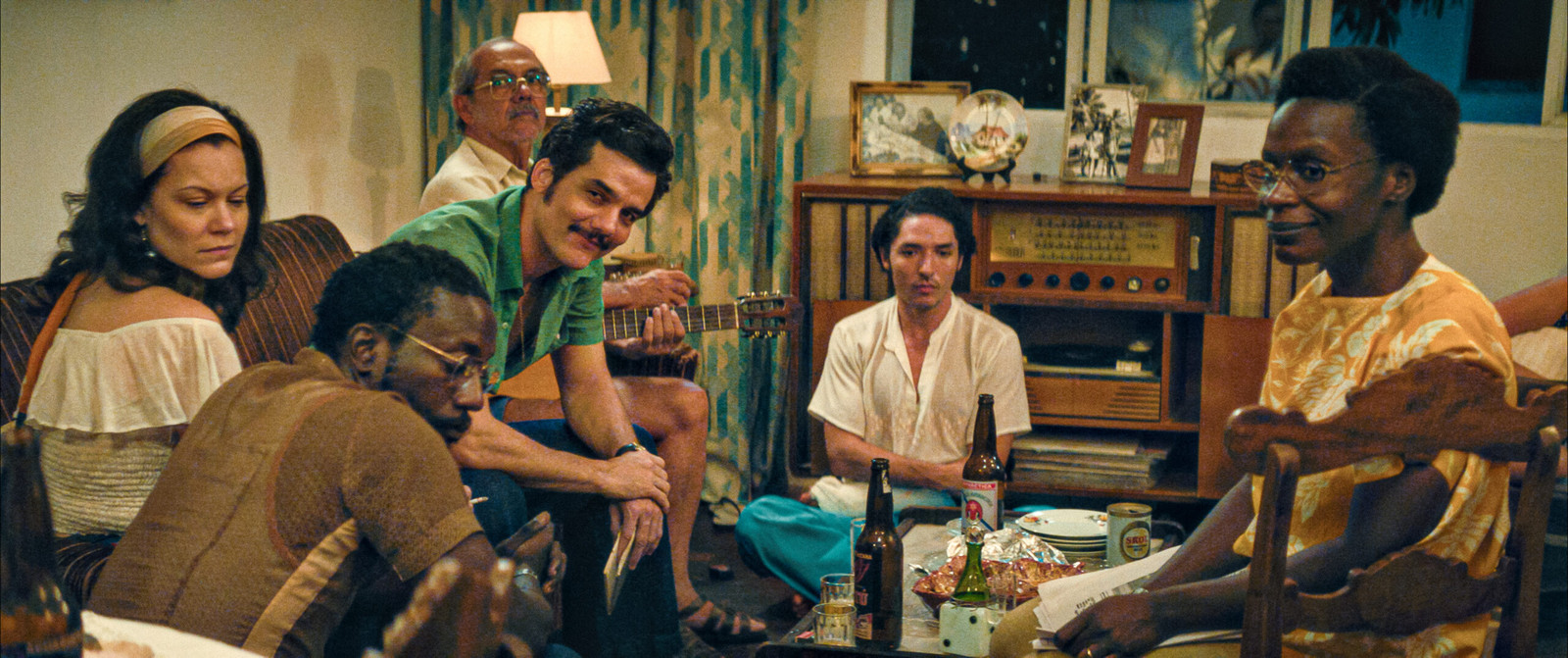
In Recife, Armando is welcomed into the apartment building of Dona Sebastiana, a feisty 77-year-old woman, delightfully played by non-professional actress Tânia Maria. With her own mysterious past surviving years in fascist Italy in the 1930s and 40s, Sebastiana bravely houses an array of various characters on-the-run for one reason or another.
We soon discover that almost no one is as they seem. Dual identities abound, all suggested by the unnerving appearance of a cat with two faces (three eyes, two noses, and two names, Liza and Elis). Armando has to reinvent himself as Marcelo Alves. He meets other temporary guests: Tereza Victoria and her husband Antonio, an Angolan couple fleeing the civil turmoil of their homeland; Clóvis, Dona Sebastiana’s principal helper, whose male relatives persecuted his less-than-macho gender presentation; Claudia, a divorced dentist/teacher, and her teenage daughter Débora. Lies or misrepresentations allow these people to go on with life.
Sebastiana is part of a loose underground organization funded by Sara Guebert (aka Elza), member of a wealthy Brazilian family, that helps people in trouble with the government or other powerful entities. Anísio is in that network and is an official in the city’s Identification Department, where Armando/Marcelo will work while he is in Recife awaiting the opportunity to flee Brazil.
As presented in this film, police officers and detectives – all sharks – form a different kind of organization. The meaning of their standard motto “Servir e Proteger” is too often to serve and protect their own self-interest and that of the wealthy and the government. The Recife chief-of-police Euclides Oliveira Cavalcanti, aided by his “White son” Sergio and his “Black like-a-son” Arlindo, is primarily dedicated to removing certain “undesirables” (rapists, homicidal robbers, and Communists) from the streets with disappearances or relentless threats.
Corruption of other sorts is examined in The Secret Agent. Ghirotti hires two high-priced hitmen, Augusto and Bobbi, to kill Armando. Even before they accept the job, they have revealed their casual evil by dumping the wrapped body of some woman into a lake. In response to Bobbi’s incautious question about the reason for her murder, his stepfather Augusto simply replies, “Inheritance and envy.” Sharks can suddenly reveal themselves in families at stressful times.
But even these professional hitmen prefer to keep their hands, if not their consciences, clean. They hire Vilmar for a fraction of what they are being paid, but a fortune to him. In an ironic costume choice, the barefoot warehouse laborer is first introduced wearing a t-shirt advertising CHESF. The Companhia Hidro Elétrica do São Francisco is an energy company, a subsidiary of Eletrobras, on whose board Ghirotti serves.
Smaller sharks – perhaps more appropriately designated as piranhas, nonetheless deadly – are capable of corruption, generally for money. One man provides the address where Armando/Marcelo lives. Another allows access to the morgue for murder evidence switching.
Just as disturbing as murder is the corruption of publications which can erase truth and destroy reputations. Even after Armando has suffered the ultimate loss, the principal Recife newspaper – an ink-spewing shark – described the 43-year-old as “involved in crimes under investigation in Brasília.” At least Dona Sebastiana was quoted as saying, “He was a good man, I am certain. That story of corruption can’t be true. He came here to start a new life, close to his son.” But the article continued with a description of Armando/Marcelo by one of the Identification Department’s employees, Elisangela, “He was suspicious all the time, with a scowling face, didn’t want to talk much. On the day of the crime itself, he got all agitated when he saw a guy looking for him at the reception.” More than likely she was just angry that he showed no interest in dating her, a romantic shark.
As counterbalance to the pervasive corruption and violence, for his setting Mendonça chose the week of Carnaval, the dramatic, joyful, rhythmic street celebration enjoyed before the onset of Lent with its a mandatory denial of pleasure by religious folks. Under the dark clouds of the dictatorship Carnaval must have taken on an even more frenzied aspect – joy and release overcoming fear and paranoia, if just for days or hours. Even Armando at one point finds himself swept up by the mood of the crowd in the street outside the Cinema Sao Luiz.
To honor his native state of Pernambuco, Kleber Mendonça had Armando/Marcelo put on a Pitombeira Olinda t-shirt, which supports a traditional carnival association formed in the coastal town of Olinda, Pernambuco. Because of the popular success of The Secret Agent, that t-shirt has now become an emblem of progressivism in Brazil, according to an article in The Guardian. It can even be purchased online.

As a dedicated filmmaker, critic, and cinema-lover, Mendonça included a famous Recife movie theater as a setting in this film – the Cinema Sao Luiz. In his joyful essay film Pictures of Ghosts (2023), the final two-thirds are focused on the movie theaters of downtown Recife that he frequented as a child and teenager. One of the actual projectionists he befriended at that time, Mr Alexandre, was resurrected by name and profession as Armando’s father-in-law in The Secret Agent.
Also periodically lightening the mood in the film are scenes involving sex. After settling into Dona Sebastiana’s apartment building, Armando/Marcelo scores a simultaneous dental checkup and make-out session with the dentist Claudia. Suggesting dark humor, that scene’s opening shot featuring a closeup of a dental pick exploring Armando/Marcelo’s teeth was preceded by Ghirotti telling the hitmen to shoot the scientist in the mouth.
When Anisio ushers Armando/Marcelo into the city archives on his first day of work, they discover a flustered policeman having sex with a prostitute behind the file cabinets. With a resigned tone of voice Anisio asks, “Again, Desiderio?” Later, when Armando points out the couple on the back row of the cinema having oral sex, the projectionist/father-in-law Mr. Alexandre shrugs it off as an everyday occurrence. Eros and Thanatos walk hand-in-hand in this film.
Mendonça loves photographs and often uses them and other still images like a Greek chorus to comment on the central action or characters of his films. A color photograph of the 29th President of Brazil (1974-1979), General Ernesto Geisel – the fourth unelected military dictator and one ironically sharing the same family name as Dr. Seuss – is seen on the walls of various government offices. Armando/Marcelo stares at one without comment (and no closeups letting us interpret facial revelations of his thoughts). A wooden cross is placed far to the left of this photo, religion as a minor afterthought.
That same photo of President Geisel is displayed in the police offices, strategically placed above a photo display titled “Swindlers and Con Artists.”
On another wall is a poorly painted portrait of a man, possibly the mayor of Recife, Antônio Arruda de Farias (1975-1979), likewise an appointed, unelected official at that time. The camera creeps toward the ugly painting and then the very next shot is of police composite sketches of criminal suspects – as if to place an equal sign between the two shots. It also humorously reminds me of Cecilia Giménez’s (R.I.P.) botched “retouching” of the flaking fresco of Jesus in Borja, Spain in 2012.
Even store advertising makes comments. In the background of one shot containing hitman Bobbi, who has foolishly followed hitman Vilmar, is a sign saying “Fuji Film, The Film of Your Life.” The “film” of Bobbi’s life will literally end a few minutes later.
Movie posters also make parenthetical comments in this film. The Omen (1976) – a tale of the Antichrist – proclaims, “He’s expecting you.” The poster for the Brazilian film O Trapalhão no Planalto dos Macacos [The Tramps on the Planet of the Apes, 1976] says everything with its title alone. A poster for the international hit Dona Flor and Her Two Husbands (1976) serves as a friendly nod to Sonia Braga, star of that film directed by Bruno Barreto and of two films by Kleber Mendonça himself.
Threading the feeling of dread throughout the film are the various images of sharks – posters and newspaper ads for the movie Jaws along with young Fernando’s drawings based on the ads as well as his own imagination. Fernando even dances to a Popeye cartoon showing the Sailorman barely escaping the jaws of a hungry shark.

Exemplifying more of the writer-director’s dark humor is the human leg found in the belly of a beached shark. That leg belongs to one victim of the police chief’s campaign of ridding Recife of those he deems undesirables, particularly those suspected of being Communists, the scourge of the dictatorship. That disconnected leg continues to travel quite a bit from the shark’s belly to the morgue to outside the police chief’s car and back into the ocean.
What at first seems to be a humorous fabrication by Mendonça is the “Hairy Leg,” presented as a newspaper cartoon and even in a short film within The Secret Agent, in which a hairy leg with no body attached terrorizes the city of Recife, especially in a cruising park where various sexual activities take place.
However, Kleber Mendonça revealed in one interview: The urban legend of the hairy leg was developed by two journalists, one of them called Raimundo Carrero. He worked in a newspaper in Recife, Diario de Pernambuco, which is featured in the film. And he came up with the hairy leg as a way, a deterrent to deal with censorship. He could not write about what actually happened involving the security forces, the police, the military police, because they were very violent against the people. So, instead of having his articles censored and slashed, he came up with the hairy leg. And he began to print straight stories, where the incidents would be described in a journalistic fashion, but instead of saying that the military forces did it, he said that the hairy leg did it. And it would come with cartoons and drawings of this zombie, disembodied leg attacking people. And it became a cultural and popular phenomenon, because, of course, the radio picked it up and did radio plays with the hairy leg.
Kleber Mendonça even added some elements from Pernambuco folklore to the pervasive tension in his film. Early on, Armando’s car is “attacked” by a caboclo de lança, a figure wearing a full-body costume of long, dried grass, topped by a red wooden mask. Although deemed a guardian of sorts, the caboclo de lança shows up again in one of Armando/Marcelo’s nightmares as a threatening entity.
In the Cannes Film Festival press conference for The Secret Agent the director explained his primary motivation for making the film:
Brazil, my country, has a problem of amnesia, loss of memory, compounded by the amnesty introduced in 1979 and proposed by the government itself. Since 1964, the government had committed endless acts of violence against the civilian population. It actually caused psychological trauma amongst the population. It became normal to commit all sorts of violent crimes and then you could just wipe the slate clean with a sponge and forge ahead and look towards the future. It’s not always nice to talk about certain things but I felt we had to speak these times. Of course, there’s a whole universe, a whole set of other ideas behind the film but this idea of memory and retaining memories is a very powerful theme.
While writing the screenplay during the presidency of Jair Bolsonaro (“Brazil’s very own Donald Trump”), Mendonça realized that certain attitudes, restrictions, and dangers prevalent during the military dictatorship were reappearing, as if the country had willingly forgotten the horrors of that earlier time.
To emphasize that theme of amnesia Mendonça added a kind of flash-forward or framing device set in the present day with two university researchers listening to audiotapes made in Recife in 1977 discussing the events surrounding the murder of Armando Solimões.
Dani, one of the young women researchers, was curious enough about the people she was listening to on the tapes that she wondered what became of the survivors. Mirroring the director’s statement about national amnesia, a Google search came up with nothing.
However, the other listener, Flavia, tracks down Armando’s son, Dr. Fernando Solimões, still living in Recife. Leaving her husband and infant child for a short time, she travels to Recife to meet the doctor at the blood bank where he works. Looking less harried, Wagner Moura cleverly played his principal character’s son.
Flavia has gone out of her way to bring the doctor a thumb-drive containing copies of the audiotapes discussing his father. She tells Dr. Solimões that the original audiotapes had to be returned to the Recife archive because fear had arisen that “sensitive information” was contained in them. Echoes of the Epstein files.
Fernando shows no excitement for this gift but very reluctantly explains the little that he knows about his father’s family history.
His father’s mother was known as “India” and worked as a servant for a wealthy family in Pernambuco. At the age of 14 she was impregnated by the 17-year-old son of that Solimões family. Armando was then raised as a Solimões and told nothing about his biological mother. That is why we see him fruitlessly searching for any information about his mother in the Identification Department. In a sense, Kleber Mendonça may be suggesting that national amnesia, especially when it comes to ethnic origins and familial connections, predates the military dictatorship for different reasons. It is as if it is best for all concerned not to examine the past.
When I lived in Puerto Rico in 1969-1970, a land of beautiful blending of ethnicities, I heard that anyone denying there was any African ancestor in the family could be simply asked, “Y tu abuela, dónde está?” [“And your grandmother, where is she?”]. The same question could have been asked in Brazil and the post-Civil War American South. Ideally, with time the response would have been proudly stated, no matter how the blending came about.
When Flavia gently tries to elicit more information about Armando from his son, Fernando stares at her and says he won’t go into that. Out of shame, fear, or simple lack of knowledge, he is also allowing conscious amnesia to cover, erase, or even “protect” the past.
As the doctor walks Flavia out of the building to catch her rideshare, he remarks that the blood bank is actually located on the very site of the São Luiz Cinema, where his grandfather Mr. Alexandre worked as projectionist. We are reminded that the material past is also erasable.
Flavia remarks that her own grandfather had lived in Recife, not far from the blood bank, on Chora Menino [“The Boy Cries”] Square. Rightly or wrongly, that square’s name makes me immediately imagine young Fernando, all dressed up and ready to leave Recife with his father in 1977, being told that afternoon that his father wouldn’t be coming after all – ever.
In reality, the doctor tells Flavia that his grandfather did finally take him to see Jaws, after which he had no more nightmares about sharks, as if to suggest that confronting one’s fears may be the surest way to overcome them.
Flavia’s Uber arrives and she bids the doctor farewell. The penultimate shot of Kleber Mendonça Filho’s brilliant film then smilingly focuses on the shark fin antenna on the car roof smoothly gliding across the screen.
The final shot shows Dr. Fernando Solimões standing in front of the blood bank on the same site where his grandfather projected movies for people to safely experience all the emotions imaginable before returning to the street and their respective realities.
