



A review of Ameneh’s Golden Blood (Khun-e Talaei-ye Ameneh), directed by Habib Ahmadzadeh.
A young woman is dying of anemia in an intensive care unit. For the third time, doctors give her a blood transfusion. Yet the following day, she remains unconscious, and her anemia persists. What is happening? Nobody knows. The situation becomes so desperate that the Iranian Blood Transfusion Organization contacts blood centers around the world, only to uncover an astonishing mystery: This patient needs an extraordinarily rare type of blood that cannot be found in any available blood bank!
This is the central premise of Ameneh’s Golden Blood, a shocking, extraordinary, and deeply moving documentary directed by Habib Ahmadzadeh. The film tells the story of a young woman from Bushehr, in southern Iran, who has just passed the national university entrance examination and is preparing to begin her studies. Suddenly, without any apparent reason, she becomes ill. Medical tests reveal that she is suffering from anemia.
Doctors give her a blood transfusion, but the next day she slips back into a coma. Further tests show that she still desperately needs blood. Another transfusion follows, apparently using the same blood group, yet her condition deteriorates further. The unfortunate young woman is dying. Doctors initially believe that she needs O-negative blood, but even blood donated by relatives with that blood type proves incompatible with her body. Everyone begins desperately searching for a way to save her life.
The Iranian Blood Transfusion Organization contacts medical centers internationally and discovers that her blood has an extraordinarily rare characteristic. According to the documentary’s account, only a handful of potentially compatible donors can be located around the world. What a terrifying predicament! An extraordinary network of compassionate physicians, medical specialists, and ordinary people mobilizes to locate compatible blood. Is there any hope of saving her? They believe that if they can obtain the necessary blood from an international medical center and overcome the obstacles created by sanctions, they may still be able to save her life.
The film opens with an overhead shot of an old courtyard and an empty chair. The camera slowly approaches the chair. A man enters the frame from behind the camera and sits down, preparing to tell us the story we are about to hear. He is the young woman’s father. From the edge of the frame, pieces of a jigsaw puzzle begin to come together, gradually revealing an image. But the puzzle remains incomplete, and the opening credits begin. It is as though the missing pieces of this puzzle must remain unresolved throughout the film, as Ameneh’s family and Iranian doctors struggle to discover how the story will end.
Facing the camera with a smile, Ameneh’s father says: “I wish Ameneh herself were here now to tell you about passing the university entrance exam and going to university.” Is this going to be a film about a young woman from an underprivileged region of southern Iran pursuing her dream of higher education?
The scene cuts back to the puzzle, now only partially assembled, and a woman begins speaking. She is Ameneh’s mother. We learn that Ameneh initially needed a blood test as part of her university registration process. Two days later, the results indicated that she was suffering from anemia and should see a specialist.
Further examinations failed to identify any underlying disease. The physician therefore prescribed medication and injections to treat her anemia. For a while, her condition improved, but after several days, she became even more seriously ill. Doctors performed a bone marrow examination. The new findings led them to reconsider her previous treatment, as they still could not establish a clear explanation for her anemia.
Ameneh stopped taking the prescribed blood-building medications, but her weakness and heart palpitations continued. Eventually, she resumed taking them. Within a day or two, her condition once again became critical. This is genuine, real-life drama. Everyone wants to know what has happened to this young woman and why the transfused blood is failing to save her. Another physician attributes Ameneh’s symptoms to a thyroid disorder and prescribes medication. But after taking it, she becomes so weak that she collapses.
From this point onward, repeated transfusions of apparently compatible O-negative blood continue, while the patient approaches death. More than eighty relatives, friends, and acquaintances volunteer to donate blood. Yet testing reveals that their blood is incompatible with hers. Worse still, the blood already transfused into her body appears to be triggering an immune reaction. Instead of accepting the donated red blood cells, her immune system attacks and destroys them. This destructive process can leave her even more anemic and physically weakened.
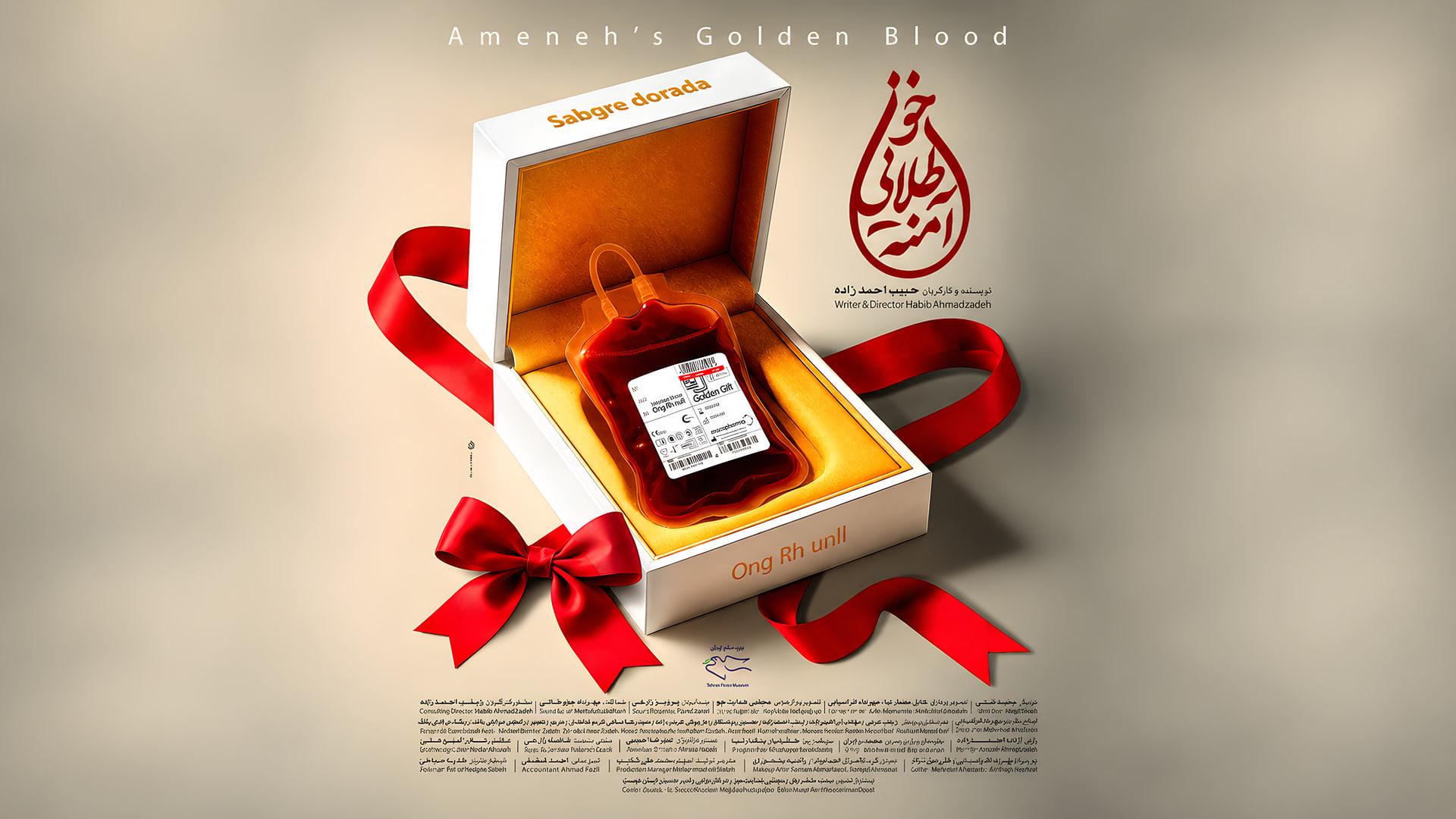
Eventually, the medical investigation reveals the extraordinary nature of Ameneh’s condition: she requires a type of blood so rare that it is known as “golden blood.” The condition is associated with the extremely rare Rh-null blood phenotype, in which red blood cells lack all Rh antigens. According to the film’s account, Iranian medical specialists identify only two individuals in the country with the relevant rare blood characteristics: a brother and sister. One has died, while the other is elderly and unable to provide the needed donation.
Under the guidance of Dr. Mostafa Moghaddam, a compassionate and determined physician, the international search continues. Two possible donors are located i n South Africa, but transporting their blood to Iran presents enormous difficulties. Another potential donor is identified in Ireland, but the individual is elderly, and no suitable blood is available in storage. Brazil and Australia reportedly possess frozen units of the rare blood, but those supplies cannot be released for Ameneh. On the eighth day of the search, the efforts of the Iranian Blood Transfusion Organization finally produce a breakthrough.
A potential donor is located in Spain. He lives in the Basque region, and through the efforts of a Spanish physician, arrangements are made for him to reach a blood donation center in Barcelona. He donates two units of blood in the hope of saving Ameneh. But another formidable challenge now emerges: how can this precious blood be transported to Iran quickly enough, especially with the restrictions and logistical difficulties associated with international sanctions?
The film presents the shipment as a race against a critical 48-hour deadline. You must see the documentary yourself to experience the suspense of these moments. At this point, we are no longer watching merely a film about an unusual medical emergency. The story moves beyond medicine and becomes an exploration of human solidarity. Ameneh is no longer the documentary’s only protagonist. Indeed, apart from an image shown during the closing credits, we never see her.
Instead, the film becomes the story of physicians who refuse to surrender, a family that struggles to preserve hope, and people in different parts of the world who do everything within their power to save the life of someone they have never met. This is precisely what elevates a documentary beyond the simple reporting of an event. Before it is a film about Ameneh, it is a film about human beings: people such as Dr. Moghaddam, and those in countries such as Spain who go to extraordinary lengths to save the life of a patient.
Ahmadzadeh includes a particularly memorable sequence in which he travels through the streets of Barcelona, carrying a backpack as he goes to meet the Spanish physician. Around him, the city is alive with movement. People are enjoying themselves, street musicians are performing, and everyday life continues with all its energy and joy. By introducing this lively atmosphere, the filmmaker momentarily distances us from the anguish of Ameneh’s situation. The sequence offers the viewer a brief emotional respite, a moment of relief amid the overwhelming tension. The documentary unfolds at a suspenseful pace, allowing different participants to reconstruct the story.
Ameneh’s family members recount their experiences, but their expressions never allow us to predict the outcome. The filmmaker carefully preserves the uncertainty, encouraging the audience to hold on to hope. And yet, when the story reaches its final moments, it does not end with the happy ending we have been hoping for.
