



From Hitler to the Commanders of Apocalypse
If one day a major film is made about the war that was waged against Iran, it would not be surprising if cinema once again followed a pattern that has appeared repeatedly in twentieth-century war films: the transformation of war-seeking leaders into the devilish figures of the narrative. In such a film, some of the political leaders who decided to initiate that war would likely be portrayed as characters issuing orders for attack from a safe distance, while the real victims of those decisions were ordinary people and civilians.

In a cinematic narrative of such a war, figures such as Donald Trump and Benjamin Netanyahu might appear as leaders whose decisions changed the fate of millions of human beings and resulted in widespread destruction and loss of life. Throughout its history, cinema has shown that once wars end and historical distance emerges, artistic narratives inevitably return to these figures and place them in roles that resemble the characters of great tragedies—individuals whose pursuit of power and ideology led them toward the destruction of others.
This approach is not unprecedented in the history of cinema. Just as films have portrayed leaders such as Adolf Hitler, Benito Mussolini, and other architects of the devastating wars of the twentieth century as symbols of historical evil, every war that shakes the world eventually finds its cinematic representation.
War has always been the stage upon which the darkest layers of human nature reveal themselves. Cinema, as an art capable of recording and recreating human experience, has returned to war again and again since its earliest decades—sometimes to celebrate heroism, sometimes to serve ideological propaganda, and sometimes to expose the dark faces hidden within this human catastrophe. Among these narratives, one of the most complex and significant elements is the depiction of evil: evil appearing in the form of ruthless commanders, war-hungry politicians, soldiers who have lost their humanity, and systems that turn human beings into instruments of destruction.
Over more than a century, war cinema has become a kind of visual archive of these devilish faces. Sometimes they appear as political leaders who initiate wars and send millions of people to their deaths. At other times they emerge as military commanders or even ordinary soldiers who, in the chaos of the battlefield, are transformed into monsters.
In the earliest decades of cinema, especially during the periods surrounding the First and Second World Wars, evil in war films was often portrayed in a simple and one-dimensional way. The enemy was presented as a faceless monster. In many propaganda films of World War II, German and Japanese soldiers were depicted as ruthless machines devoid of humanity. The goal of such portrayals was to strengthen national morale and create hatred toward the enemy.

As time passed and historical distance from these wars increased, cinema began to approach the concept of evil in war with greater complexity. One of the earliest films to present a profound image of the tragedy of war was All Quiet on the Western Front (1930), based on the novel by Erich Maria Remarque. This film does not glorify war; instead, it portrays war as a machine that devours an entire generation of young men. In it, the military establishment—those who sit safely behind the lines while sending young soldiers to their deaths—represents a structural form of evil.

In Paths of Glory (1957), directed by Stanley Kubrick, one of the most shocking portrayals of moral corruption within military power appears. French generals sentence three innocent soldiers to death merely to preserve the honor of the army. The decision is not made out of military necessity but out of pride and ambition. Kubrick reveals how power and arrogance can transform individuals into morally monstrous figures.

Perhaps one of the most complex embodiments of evil in war cinema appears in Colonel Walter E. Kurtz in Apocalypse Now (1979), directed by Francis Ford Coppola. Kurtz is a commander who has concluded that victory in war requires abandoning all moral boundaries. Deep in the jungles of Cambodia, he has created a personal domain where his soldiers worship him almost as a dark god. Kurtz represents the terrifying question at the heart of many war films: can war transform a human being into a monster?

A similarly disturbing character appears in Platoon (1986), directed by Oliver Stone. Sergeant Bob Barnes is a soldier whose humanity has been destroyed by war. Barnes commits acts of violence without hesitation and shows little regard for civilian lives. In contrast stands Sergeant Elias Grodin, who still struggles to preserve a sense of humanity. Their conflict symbolizes the moral crossroads faced by soldiers in war.

In Full Metal Jacket (1987), Stanley Kubrick again examines the machinery that produces violence. The character Gunnery Sergeant Hartman represents institutional brutality. Through humiliation and psychological violence, Hartman attempts to transform young recruits into killing machines. In his worldview, humanity is an obstacle to becoming a perfect soldier.

One of the most terrifying portrayals of evil in cinema appears in Schindler’s List (1993), directed by Steven Spielberg. The character Amon Göth, the commandant of the Płaszów concentration camp, treats murder as a form of entertainment. The scenes in which he casually shoots prisoners from the balcony of his villa have become some of the most chilling images ever created in cinema.
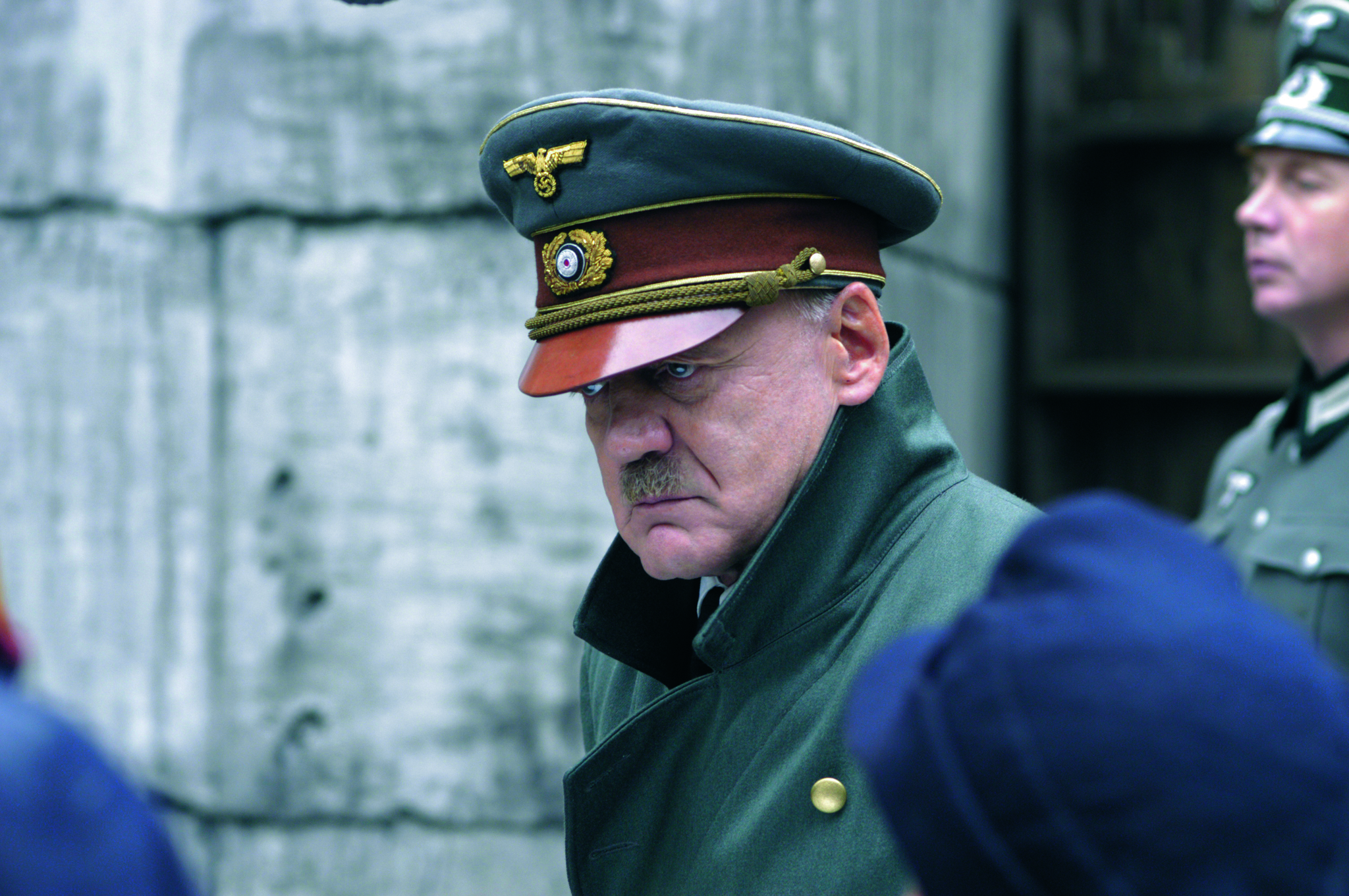
In Downfall (2004), directed by Oliver Hirschbiegel, Adolf Hitler is portrayed during the final days of the Third Reich. The film depicts him not only as a tyrant responsible for unimaginable destruction but also as a man trapped within the delusions of his ideology. Even in the face of total defeat, he refuses to acknowledge reality, continuing to sacrifice millions to his catastrophic vision.
Another striking villain appears in Quentin Tarantino’s Inglourious Basterds (2009): Colonel Hans Landa. Landa is a Nazi officer whose polite manners and charming demeanor conceal a ruthless intelligence and sadistic cruelty. The contrast between civility and brutality makes him one of the most memorable villains in modern war cinema.

In Saving Private Ryan (1998), directed by Steven Spielberg, war is depicted with brutal realism. The opening sequence depicting the Allied landing on Omaha Beach remains one of the most powerful scenes in film history. In this film, even enemy soldiers are portrayed as human beings struggling to survive. This humanization makes the violence of war even more painful.
In the Soviet masterpiece Come and See (1985), directed by Elem Klimov, one of the most horrifying depictions of wartime cruelty appears. Nazi forces massacre entire villages in Belarus. The film presents war as a collective monster that devours innocence and destroys the psychological world of its young protagonist.

Japanese cinema has also explored the moral collapse brought about by war. Fires on the Plain (1959), directed by Kon Ichikawa, portrays starving Japanese soldiers stranded in the Philippines during the final days of World War II. In their struggle for survival, they cross unimaginable moral boundaries, illustrating how war can dissolve the ethical foundations of human life.
War cinema often reveals that evil is not confined to the enemy. In Paths of Glory, the true enemy of the French soldiers is not the German army but their own commanders. In Platoon, the most frightening violence sometimes comes not from Vietnamese fighters but from American soldiers themselves. These films challenge the simplistic notion that moral clarity exists on the battlefield.
One of the most important achievements of modern war cinema is its rejection of simplistic portrayals. In many contemporary films, the enemy is no longer a faceless monster but a human being with a life, family, and dreams. This humanization transforms war into a deeply tragic experience rather than a heroic spectacle.
Ultimately, war cinema reminds us that evil does not originate only on the battlefield. Many wars begin in rooms of power where political leaders make decisions that shape the fate of millions. The distance between those who make the decisions and those who suffer the consequences is one of the central moral themes explored by war films.
The devilish faces of war in cinema function as mirrors reflecting the darkest aspects of humanity. These films remind us that war destroys not only cities and landscapes but also the moral and spiritual foundations of human life.
Perhaps this is the greatest responsibility of cinema: to ensure that the true faces of evil are not hidden behind propaganda or official narratives. The greatest war films do more than reconstruct battles—they reveal the human decisions that lead to catastrophe.
And perhaps one day, when filmmakers look back at the wars of our own time, they will do what cinema has always done: show the faces of those who started the wars, and the ordinary people who paid the price.
For history repeatedly demonstrates that in every war there are heroes and victims—but behind the scenes there are always individuals whose decisions shape the tragedy itself. And it is those individuals whom history ultimately remembers not as victors, but as the architects of disaster.
