



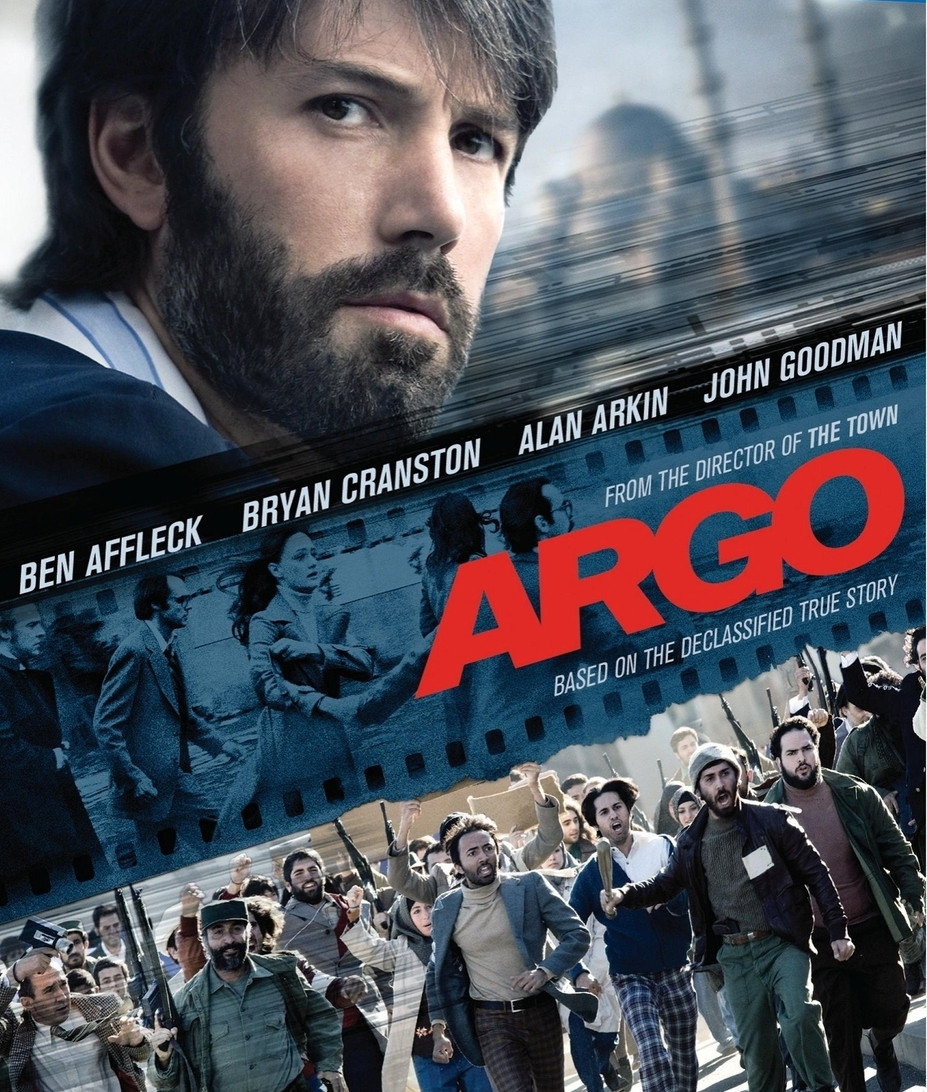
Ben Affleck’s Argo is a disturbing example of how Hollywood can manipulate historical events to produce a politically convenient and commercially appealing thriller. Based on the true story of six American diplomats who escaped from Iran during the 1979 hostage crisis, the film presents itself as a serious reconstruction of history. What we actually get is a shallow, historically misleading, and poorly directed film that replaces political understanding with manufactured suspense and reduces one of the most complicated periods in modern Iranian-American relations to a simplistic confrontation between American heroes and Iranian villains.
What bothers me most about Argo is not merely its distortion of individual events but its failure to seriously examine why the American Embassy was occupied in the first place. Affleck provides a brief historical introduction acknowledging the 1953 coup and American involvement in Iran, but this is little more than a hurried summary, quickly forgotten once the film begins its celebration of American intelligence and heroism. The central historical questions remain largely unexplored. Why had resentment toward the United States reached such an extraordinary level in Iran? What had Washington done during the twenty-six years between the overthrow of Mohammad Mossadegh and the Iranian Revolution? And why did so many Iranians believe that the American Embassy might once again become the center of an operation against their country’s political independence?
In 1953, the democratically elected government of Prime Minister Mohammad Mossadegh was overthrown in a coup organized with the involvement of American and British intelligence agencies. Mossadegh had challenged British control over Iran’s oil industry by nationalizing it, a decision that made him a symbol of Iranian independence and national dignity. The American government, acting in the atmosphere of Cold War fears and alongside British interests, helped destroy a government that represented an important attempt to establish constitutional democracy in Iran.
The consequences of that intervention were enormous. Mohammad Reza Shah Pahlavi returned to power, and for the next twenty-six years the United States became his most important international supporter. Washington provided military assistance, sophisticated weapons, intelligence cooperation, and political legitimacy to a monarchy that increasingly depended on authoritarian rule. The Shah’s security organization, SAVAK, became notorious for surveillance, imprisonment, and torture of political opponents. The United States helped establish and train this security apparatus and continued supporting the Shah despite growing awareness of political repression in Iran.
For millions of Iranians, the United States was therefore not simply another foreign government. It was the power that had helped overthrow their prime minister, supported the monarchy, and strengthened an oppressive political system. American influence was visible in the military, security services, economy, and political life of the country. By the late 1970s, resentment against the Shah and hostility toward American interference had become inseparable in the minds of many Iranians.
These are not insignificant details to be compressed into a few introductory images. They are essential to understanding the events that Argo claims to portray.
When the Shah was admitted to the United States for medical treatment in October 1979, many Iranians feared that Washington might attempt another intervention, just as it had in 1953. The seizure of the American Embassy on November 4, 1979, grew out of these fears, accumulated anger, and the internal political struggles following the revolution. The hostage-taking was wrong, and holding innocent diplomats captive cannot be justified by the past actions of their government. But understanding why an event occurred is entirely different from approving of it. A serious political film should recognize that distinction.
Affleck appears unwilling to explore it.
Instead, he gives us an Iran populated mainly by furious crowds, suspicious officials, armed revolutionaries, and threatening faces. Ordinary Iranians are almost invisible. We see little of the country’s political diversity, its intellectual life, the competing forces within the revolution, or the fears and hopes of a population that had just experienced the collapse of a monarchy. Iranians are not presented as complicated human beings shaped by history. They are primarily obstacles standing between the Americans and their escape.
This is especially disappointing because the revolution itself was not a simple or unified movement. Liberals, nationalists, leftists, religious groups, students, workers, and many others participated in the opposition to the Shah, often with very different visions of Iran’s future. The embassy seizure also became an instrument in the struggle for power among the revolutionary forces. None of this complexity interests Affleck. His Iran is a convenient setting for danger, not a society worth understanding.
The film’s historical dishonesty becomes even more obvious in its treatment of the rescue operation itself. The real operation was an extraordinary example of intelligence, patience, careful planning, and international cooperation. Canadian Ambassador Ken Taylor and other Canadian officials played essential roles in protecting the Americans, while CIA officer Tony Mendez developed the ingenious idea of disguising them as members of a Canadian film crew. Their success deserves recognition, but the story hardly needed Hollywood’s inventions.
Affleck, however, seems convinced that audiences cannot appreciate an intelligent operation unless it ends with a ridiculous action sequence. In the film’s climax, Iranian officials discover the identities of the fleeing Americans, rush to the airport, and pursue their aircraft down the runway. This sequence is entirely fictional. The real departure was comparatively uneventful. The Americans passed through airport formalities and escaped successfully without the dramatic confrontations or desperate chase invented for the film.
This is not an innocent change made for cinematic purposes. It transforms a remarkable achievement based on secrecy and preparation into an absurd last-minute escape. Instead of respecting the intelligence of the audience, Affleck assumes that a successful operation must resemble a conventional Hollywood action movie.
The treatment of the Canadian contribution is equally questionable. Although Canada played a central role in sheltering the Americans and making their departure possible, the film directs almost all our admiration toward Mendez and the CIA. John and Zena Sheardown, who sheltered four of the six Americans, are effectively eliminated from the story. What was a courageous international effort becomes another familiar tale of an American hero saving the day.
This distortion reveals much about the film’s intentions. Argo is less interested in reconstructing history than in producing a reassuring image of American competence and moral superiority. The country whose government helped overthrow Iran’s elected prime minister in 1953 is now presented almost exclusively as the innocent victim of Iranian hostility. The past is acknowledged just long enough to create an appearance of fairness, then pushed aside to make room for a patriotic adventure.
But even if we put politics and historical inaccuracies aside, Argo is a disappointing piece of filmmaking.
Affleck’s direction is unimaginative and frequently heavy-handed. He depends on rapid editing, ominous music, exaggerated confrontations, and predictable complications to create tension. Almost every suspenseful moment follows a familiar formula: the characters are about to succeed, something suddenly goes wrong, danger increases, and an improbable solution arrives at the last possible second. This is mechanical filmmaking that mistakes manipulation for suspense.
A talented director could have found genuine drama in the emotional experiences of the six Americans: their fear of discovery, their dependence on their Canadian hosts, their isolation, and the terrible uncertainty of living in a country undergoing profound political transformation. The psychological tension of waiting, of pretending to be someone else, and of trusting strangers with one’s life could have created a far more intelligent and moving film.
Affleck instead chooses artificial excitement over psychological depth. His characters rarely develop into fully realized human beings. The six Americans are defined largely by their anxiety, while Tony Mendez, played by Affleck himself, remains a conventional, emotionally restrained American agent. Even the personal difficulties introduced through his family life feel like a borrowed Hollywood device intended to give a thinly developed hero some emotional weight.
The scenes involving Hollywood personalities, played by John Goodman and Alan Arkin, provide moments of humor, but they also expose another weakness in the film’s direction. The shifts between playful Hollywood satire and supposedly serious political drama are awkward. Affleck never fully establishes a coherent cinematic tone. The contrast might have worked in the hands of a director with a more original vision, but here it feels like two different films joined together by a clever premise.
Nor is the film particularly impressive visually. Its period details and production design are convincing enough, yet its images lack the depth and individuality that distinguish memorable political cinema. Tehran is photographed and edited primarily to suggest menace. Crowds appear as anonymous masses, streets become threatening passageways, and the camera rarely seems interested in observing anything beyond the immediate needs of the thriller.
One of the responsibilities of a director dealing with actual historical events is to distinguish between exploiting a political situation and understanding it. Affleck seems content with exploitation. He wants the danger of revolutionary Iran without its historical complexity, the excitement of the rescue without the ordinary realities of the operation, and the satisfaction of American heroism without serious consideration of American responsibility.
There is a profound irony in a film about a fake Hollywood production becoming, in its own way, a Hollywood fabrication of history. The imaginary science-fiction movie created as a cover for the rescue operation was a brilliant deception designed to save human lives. Affleck’s Argo, on the other hand, uses cinematic deception to turn a complicated historical event into a simplistic entertainment.
I have no objection to filmmakers interpreting history or using imagination to bring historical events to the screen. Some of the greatest films ever made have done precisely that. But artistic freedom should serve a deeper understanding of human experience. When historical facts are repeatedly changed merely to make a story more exciting or politically comfortable, the result becomes questionable not only as history but also as art.
The real story behind Argo is fascinating because it brings together people from different countries who worked under dangerous circumstances to protect human lives. It also takes place against the background of a tragic relationship between Iran and the United States, a relationship shaped by decades of political interference, mistrust, and missed opportunities. Both elements offered Affleck rich material for a thoughtful and powerful film. He has wasted that opportunity.
Instead of a serious examination of history, we receive an ordinary Hollywood thriller dressed in the clothes of political significance. Instead of complicated human beings, we are given convenient heroes and faceless enemies. Instead of examining the roots of the hostage crisis, the film asks us to forget them and concentrate on the excitement of an invented airport chase.
The American diplomats held hostage in Tehran were victims of an unacceptable act, and their suffering deserves sympathy. But the Iranian people, too, had suffered from years of foreign interference and domestic repression, much of it sustained by the political and military support of the United States. Recognizing one injustice should not require erasing the other.
Argo could have been a film about the dangerous consequences of political intervention, the enduring wounds of history, and the courage of ordinary people caught between governments. Instead, Ben Affleck has produced a film that is historically selective, dramatically superficial, and artistically uninspired.
The greatest failure of Argo is not simply that it changes what happened during the escape. It is that it avoids seriously confronting what happened in Iran during the twenty-six years before the American Embassy was occupied. Without that history, Affleck’s film offers us excitement without understanding, heroes without complexity, and a false sense of truth.
Hollywood may celebrate Argo as an accomplished political thriller. I see it as another example of an American film industry far more comfortable rewriting history than confronting it.
